
The Case Against Perpetual Transformation.
For my entire professional career, we have been in a state of transformation. At some point, you have to exercise the muscles you built and get serious about being great at change itself.


For my entire professional career, we have been in transformation, and I am calling it done. At some point, you have to exercise the muscles you built and get serious about being great at change itself. That is a different discipline than transforming, and it is exactly what The Select Group (TSG) helps enterprises do.
I have spent more than twenty years helping enterprises transform. I do not say that with exhaustion, but with the kind of perspective that only comes from having lived the full arc several times over, with the scars to tell their own stories. Twenty years is long enough to have ridden a few waves: the web build-out of the early 2000s, the digital transformation decade that followed, the methodological revolution that reshaped how teams work, and now the AI era that is reordering everything again. I have helped guide organizations through all of it as an engineer, architect, executive, and thought leader contributing to one of the most significant operating frameworks of modern history. Reflecting on all of it, I have noticed something that nobody else seems to be ready to discuss.
We have been transforming the same organizations over and over again. We have called it progress. In some cases we have even declared victory, and at the time, rightly so. Then leadership changes, people change, the transformation is declared “done,” and progress goes into regression.
Each wave arrived with genuine urgency and a solid business case. Each was the right thing at the time. Companies that did not build for the web lost. Companies that did not modernize their digital customer experience became irrelevant.
But somewhere between the first wave and this one, the enterprise stopped treating transformation as a response to a specific forcing function and started scoping it as a permanent program. The transformations kept rolling. The capability transfer rarely made it into the next evolution.
Here is what I believe after watching this cycle repeat for two decades: the problem is not the ambition. The problem is that we never built the muscles to stay changed.
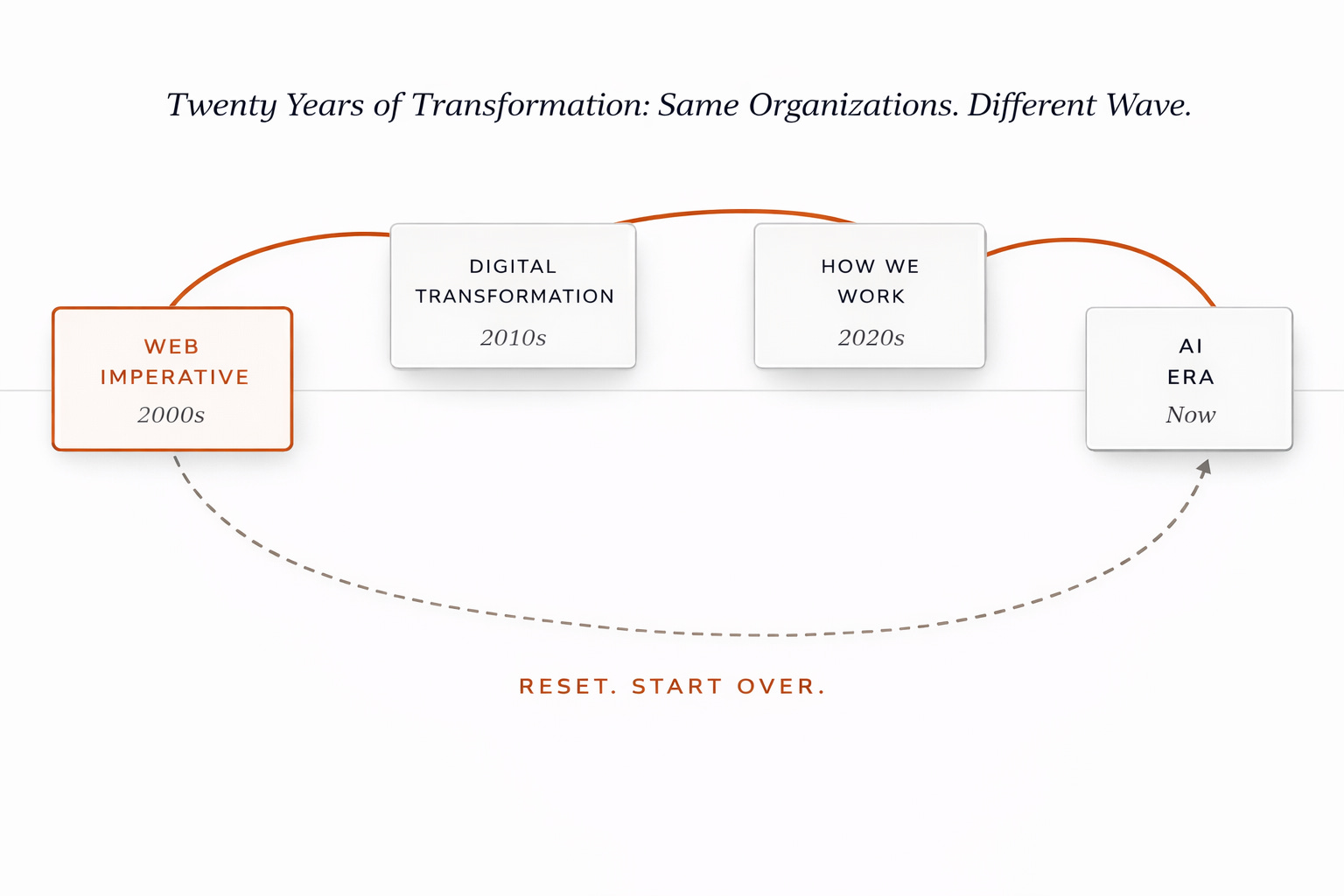
The Wave Pattern
The web work came first. We built the digital storefronts, stood up the e-commerce infrastructure, moved the customer interaction layer online. That was genuine, consequential transformation. It was actually the foundation for my first real business, Carzz. The platform, pre-Cars.com, helped powersports and auto dealers easily manage their inventory on their very own .com. What a time that was. The .com era rewired business models and forced organizations to develop capabilities they had never previously needed. The companies that did it well came out structurally different.
Then came the broader digital transformation era. The mandate expanded beyond the customer-facing layer: data strategy, cloud architecture, experience design, platform thinking. Enterprises made enormous investments and brought the customer closer than ever. BCG’s global study of over 850 companies found only about one in three of those initiatives delivered on their stated value targets.
I personally led a digital transformation at an education consortium spanning 86 universities, 22 campuses, and 5 geographic regions. The impact was profound in terms of operational efficiency, student experience, and EBITDA gain, only to be eroded nearly as soon as the work was complete by a series of divestitures.
Then the wave shifted to how organizations work. Faster delivery, modern operating structures, rearchitected team models. The underlying problem was obvious: the delivery vehicle at most large enterprises was a product of the industrial age. It had to be shifted for a world where knowledge and context drove innovation. But the solution got packaged and industrialized in ways that prioritized repeatability over fit. Many organizations emerged with new processes layered on top of the same structural problems that made the work slow in the first place.
Now here comes AI. And I will tell you exactly what I tell every executive I sit across from: if you approach this wave the same way you approached the last three, you will get the same result. A program. An engagement. Measurable gains at close. And eighteen months later, someone in your organization asking what the next thing is. The gains will not stick, and the pain will be much greater this time than any previous wave due to the speed and scope of AI tooling. If you do not approach this differently, you will compound the friction already in the system, and you will fail.
A 2024 Bain analysis found that 88 percent of business transformations fail to achieve their original ambitions. Not a slim majority. Eighty-eight percent. The failed efforts cost organizations an estimated $2.3 trillion annually. We have been spectacularly, consistently bad at the thing we have been selling for two decades.
I do not think the problem is incompetence. I think it is something more structural, and more fixable.
“At some point, you have to stop getting in shape and start being an athlete. Those are not the same thing.”
I run six days a week. Cold plunge to start, sauna to finish. I have done it long enough to understand the difference between transformation and performance. Year one, you are chasing a distance. Year three, you are not transforming anymore. You are performing, and your goal shifts to sustainability and efficency. The gains are harder and slower, but they do not evaporate when you miss a week. You built the version of yourself that just keeps getting better. But you recognize that if you do not care for the system you have built, it will fail.
Enterprises need to make the same shift. The goal is not to complete a transformation. The goal is to build the operating model, the team capability, and the organizational reflexes that make improvement the default, and then seek sustainability in that system. This is a fundamentally different discipline than how most companies have operated throughout history. And most transformation programs were never designed to leave it behind.
Why the Model Keeps Failing
I want to be careful here, because I have been on both sides of this. I have run transformation programs. I have landed the engagements. And I have a lot of respect for the practitioners doing this work. The problem is not the people. The problem is how the work gets scoped.
Transformation programs are built to have an end. Scope, timeline, deliverables, handoff. That structure makes sense when you are solving a discrete, bounded problem. It does not make sense when the underlying issue is an organization’s ongoing capacity to absorb change. The mistake is not in the engagement itself, but in the scoping: optimized for delivery of a defined output rather than transfer of a durable capability. When the program ends, if building that internal muscle was never part of the scope, the decay begins. And even in the cases where internal discipline was established, organizational politics typically prevent the same level of transparent conversation that is free to take place between external advisors. Internal team members tend to call these crucial conversations CLMs: career-limiting moves.
I watched this play out at a major financial services firm. A large investment of time and capital was made over many years, and meaningful results were delivered from a talented team. Release frequency improved materially. Teams were better aligned. The metrics looked strong at program close. Two years later, the gains had largely reversed. Leadership was gone, new perspectives were brought in, reductions happened, and trust vanished. This did not happen because the organization lacked commitment, and not because the consultants did poor work. Because capability transfer was not in the scope, and the change had not been made foundational to how work was done at the enterprise, it did not stick when pressured by new voices. They had been handed a transformation. They had not been built into an organization that could own one.
McKinsey’s organizational health research adds an edge to this: performance transparency (the internal capacity to measure, see, and act on improvement feedback) appears in only four percent of transformation programs. The single practice most correlated with sustained gains is the one that almost never makes it into the statement of work.
The Structural Problem
Harvard Business Review noted last year that the traditional transformation model, rooted in Lewin's 1950s "unfreeze, change, refreeze" framework, was designed for discrete projects. It was never designed for an environment where the external landscape evolves faster than any single program can address. The organizations that outperform are the ones that have built change into their operating rhythm permanently, not as an initiative, but as a core organizational competency.
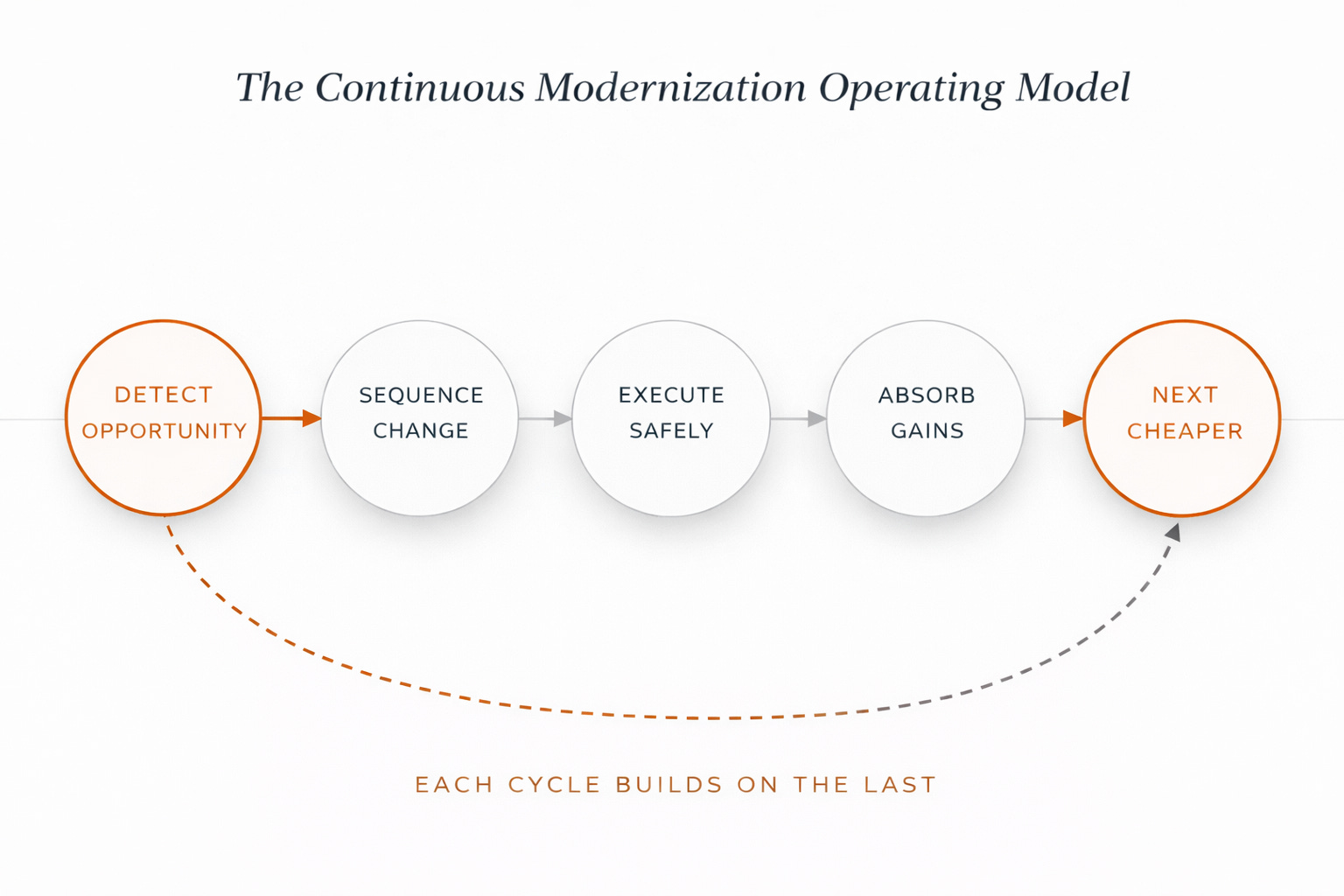
What Comes After Transformation
There is a better model, and I have seen it work at Fortune-50 enterprises with organizational gravity and firm resistance to change. The organizations that break the transformation cycle share a common set of characteristics, and none of them are mysterious.
These organizations treat their delivery model as a product. A product has an owner, a roadmap, a continuous improvement cycle built in. They apply the same rigor to the machinery of delivery that they apply to the products they ship. Ownership is permanent. Investment is operational, not capital. The improvement cycle does not close.
They build internal instrumentation before anything else. You cannot improve what you cannot see, and most organizations cannot see their own delivery system with any precision. The ones that sustain their gains have invested in flow measurement, quality signals, and structural friction visibility. They have built the systems to surface problems continuously, which means that when outside expertise comes in, it can go deeper faster, because the organization already knows where the drag is.
They close the loop between technology adoption and delivery capacity. This is the most urgent gap right now. AI tooling has accelerated development velocity at a pace that most downstream governance, quality, and release infrastructure was never designed to absorb. The organizations getting this right are not just adopting the tools. They are retooling the systems downstream to match the velocity the tools create upstream. The ones who are not are building fragility they cannot yet see.
And they develop leaders who own the change, not just sponsor it. Executive sponsorship is table stakes and everyone knows it. What actually determines whether an organization sustains its gains is whether there are leaders inside the delivery organization, not above it, with the knowledge, authority, and credibility to make ongoing modernization decisions without escalating every one of them. Those leaders are not hired. They are built, deliberately, over time.
“Most organizations are not stuck because they lack the ambition to change. They are stuck because they have built every muscle except the one that makes change self-sustaining.”
This is what I mean by continuous modernization. We do not want to launch another program. We do not want to rebrand a transformation. We aim to co-create an operating model where the organization's ability to detect what needs to change, sequence it, execute it, absorb it, and apply it to the next thing is built permanently into how the business runs. The measure of success is not program completion, but organizational self-sufficiency: the point at which the external partner is no longer necessary because the capability is owned.
AI Is Accelerating the Gap
A few weeks ago I published a piece on the AI Development Lifecycle. The argument: AI-native work operates by different rules than conventional software delivery, and organizations governing it with models built for a different era will underperform. I stand by every word. But there is a layer underneath it that connects directly to everything I have said here.
AI is accelerating the divergence between organizations that have built the continuous modernization competency and those that have not. If you have the internal instrumentation, the adaptive governance, and the change-ready delivery culture already in place, AI adoption amplifies your advantage. You absorb the capability, retool downstream to match the new velocity, and come out ahead of every competitor still running the transformation program model.
If you do not have that foundation, AI adoption accelerates your fragility. It makes a poorly-structured delivery system produce more output, more quickly, in more directions, with less visibility. That is not speed. That is scale-up failure on a faster timeline.
The organizations that win this era will not be the fastest AI adopters. They will be the ones with the absorptive capacity to translate AI capability into sustained competitive advantage. Closing that gap is, without qualification, the most consequential work available to enterprise technology leaders right now.
The Human Cost
I want to close with something that does not surface in executive conversations the way it should, because it lives below the waterline in the people doing the work.
The program manager who has built the deck, run the kickoff, earned the team’s trust, and delivered the results. Three times now, on three different initiatives with three different names. The technology leader who has stood in front of her organization and made the case for the new way of working, again, with genuine conviction, watching the skeptics in the back row who have seen this before. The delivery professional who poured himself into the work, watched it take hold, believed it this time, and then watched a leadership change quietly undo two years of progress in a single quarter.
These are not cynics. They were believers. And somewhere along the way, the model made them cynical.
That is the human cost of perpetual transformation. It does not show up in a program dashboard. It shows up in the leader who stops raising her hand. The engineer who updates his resume every time a new initiative kicks off. The institutional knowledge that walks out the door because they stopped trusting that the work would last.
When my son Ford was born, something shifted in how I think about the things worth doing. I wrote about it at the time: the move from training for vanity to training for longevity. The work I am most proud of in my career has that quality. It lasted. The organizations that own it today do not think of it as a transformation they survived. They think of it as how they operate. Change is not a program to them. It is a reflex. A competitive advantage.
That is the version of your organization that we need to build. Not the one that completes the next transformation. The one that never needs another one.
Ready to build the muscle?
TSG helps enterprises build the internal capability to modernize continuously, not episodically. If your organization is ready to stop starting over and start building change resiliency, let’s talk.