

On October 9, 2025, Figure AI released a six-minute video of its Figure 03 robot folding laundry, loading a dishwasher, pressing the buttons on a washing machine, and tossing a ball to a family dog. It went on the cover of TIME’s Best Inventions issue. The official YouTube cut crossed 5.5 million views. The clips ran on every tech feed I follow for about a week.
The robot is not going into homes. Figure’s CEO told TIME, in the same piece, that the Figure 03 would not be ready for domestic use at launch and that getting there would be “a big push.” TIME’s own reporter watched the prototype drop laundry on the floor twice in a row.
A few hundred miles south, a different Figure robot had spent the previous ten months on the production line at BMW’s Spartanburg, South Carolina plant, placing sheet metal parts into welding fixtures. It contributed to more than 30,000 vehicles. You can find one news story about it if you go looking. It did not trend.
This is precisely the categorization problem. The word “humanoid” is being used to describe two machines from the same company, doing two completely different jobs, with two completely different deployment paths, and the conversation treats them as the same thing. They are not the same thing. Not even close.
Four categories
Almost everything that gets called a “humanoid robot” in 2026 falls into one of four buckets. The buckets have different buyers, different physics, different software stacks, and different timelines. Conflating them is confusing everyone.
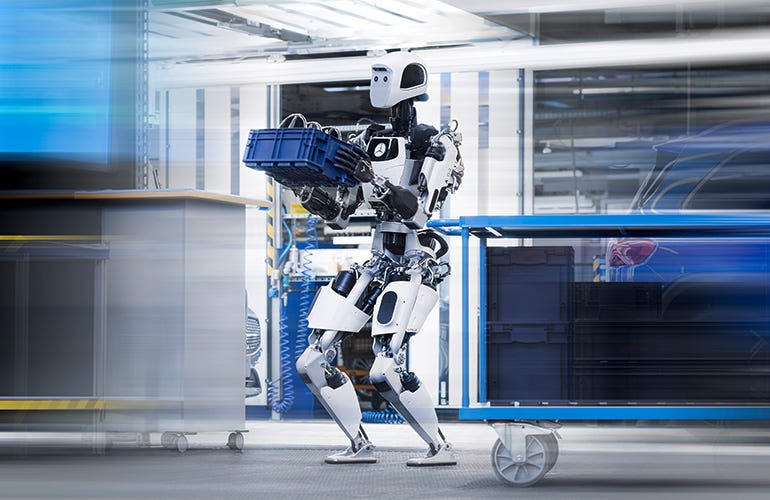
Bipedal logistics movers. Robots that walk on two legs through structured warehouse or factory environments, moving totes, bins, and parts between fixed points. Agility Robotics’ Digit at GXO and Amazon warehouses. Apptronik’s Apollo doing lineside delivery for Mercedes (25 kg components to specific workstations on a schedule). The work is repetitive, the environment is mapped, the failure modes are well understood. This is the most boring category and by some margin the most real.
Fixed-station manipulators in humanoid form. Robots in human shape doing one or two well-defined manipulation tasks at a fixed station, alongside or in place of a human worker on a structured line. Figure 02 at BMW Spartanburg. Tesla Optimus on Tesla factory floors. The “humanoid” part is mostly a cost argument: the workstation was designed for a person, so a person-shaped machine doesn’t require a line redesign. This category is legitimate, and most enterprise pilots are this category once you read past the press release.
Mobile manipulators for unstructured environments. Robots intended to walk through messy human spaces and do open-ended tasks. The home robot. The hospital robot. The mixed-use facility robot. This is what the Figure 03 demo video is selling, what 1X’s NEO ad copy is selling, and what the cover of TIME implied was a 2025 reality. It is not a 2025 reality, and on the evidence available it is not a 2026 reality either.
Teleoperated robots in autonomy clothing. Bipedal manipulators in homes or facilities where a remote human operator is doing the actual cognitive work, and the robot is providing the body. NEO Gamma’s “Expert Mode” is a good example. WSJ’s Joanna Stern, after a hands-on demonstration, reported she “didn’t see Neo do anything autonomously”; every action was driven by a skilled remote pilot named Turing. 1X has been refreshingly honest about this. The launch material describes the model as “autonomous + call for human assistance when NEO can’t do a task, like how Waymo is operated & supervised.” That is a fair description of the technology. It is also a different product than the demo videos make it look.
A fifth thing happens on top of these four, and it is not a category of machine but a category of marketing: the AI in a body pitch. The framing is that a sufficiently large foundation model, dropped into any plausibly humanoid chassis, will produce general-purpose competence. The investor presentations require this framing even though the technical evidence does not yet support it. I am keeping it separate because it is a story about funding rounds, not a story about deployments.
Which of these can you buy in the next 24 months
Buckets one and two: yes. With caveats, but yes. Apptronik raised $520 million in February 2026 at a $5 billion valuation and is shipping into Mercedes and GXO. Agility’s RoboFab facility is scaling from hundreds to thousands of Digit units. Figure has BMW. Apollo will build Apollo at Jabil. The procurement story for these is much closer to “industrial automation with a different form factor” than to “general-purpose robot.” It looks more like buying a sortation system than buying a coworker.
Bucket three: no. Not at any scale that justifies a serious budget line in your 2026 or 2027 plan. The technology is interesting, the progress is there, and Figure 03 in three years may be even more interesting. But if you are a CIO or COO being pitched on humanoids that will work in unstructured environments inside your business in the next two years, you are being pitched aspiration.
Bucket four: this one is trickier. You can buy NEO today, for $20,000 or $499 a month. What you get, in 2026, is mostly a teleoperated robot whose autonomous mode is improving in the background while you and a remote 1X operator do the work together. That may be a defensible thing to buy if you understand it for what it is. It is not a defensible thing to buy if you thought you were buying bucket three.
Why the conflation persists
The conflation is not an accident.
It serves founders raising at $5 billion valuations on the implicit promise that a single platform will handle warehouses, factories, eldercare, and homes. The conflation is the whole pitch. Tease the household demo, sell the factory pilot, raise on the implied path between them.
It serves journalists and analysts whose engagement numbers reward the household demo and punish the welding-fixture deployment. A robot folding laundry beats a robot bolting sheet metal every time, even when the second one is the deployment story.
It serves consultants and analysts selling forecasts that treat “the humanoid market” as one $200 billion line by 2035. The number is large because it bundles four very different markets together and assumes they will all materialize on the optimistic timeline of the loudest one.
The people it does not serve are plant operators. Procurement teams scoping pilots. Workforce-planning teams modeling what to do with the line workers whose stations might be automated in the next thirty-six months. CFOs trying to figure out whether to put a number in the 2027 plan or the 2030 plan. Every one of these decisions gets worse when “humanoid” means four different things in the same sentence.
It also does not serve the workers inside those decisions. A line worker at a Spartanburg plant has a different conversation with their family if the honest framing is “a fixed-station manipulator is being trialed for sheet-metal placement on my line, here are the three jobs that are most exposed, and here is the retraining we’re doing in the next six months.” That conversation is hard but it is grounded. The conversation “a humanoid robot is coming for my job” is neither hard nor grounded.
The vocabulary I’m going to use
For the rest of this series, when I say “humanoid” I will mean one of four things, and I will say which:
Bipedal logistics mover for the Digit-and-Apollo-in-warehouse case.
Humanoid-form station manipulator for the Figure-02-at-BMW case.
Mobile manipulator for unstructured environments for the home-robot aspiration. (No good short name has stuck yet. The fact that the marketing category is bigger than the engineering category is part of the problem.)
Teleoperated humanoid for the NEO-and-Expert-Mode case, with the understanding that the autonomy will increase over time and the category may eventually graduate into one of the others.
These are not branded terms and I am not going to defend them past the next person who proposes a better one. The point is to have four words instead of one. If a vendor pitch can’t be placed cleanly in one of the four, that is telling about the pitch.
The Figure 03 video is a beautiful piece of marketing about a real research program. The BMW Spartanburg deployment is an unbeautiful piece of industrial automation that is already inside a building making your next SUV. Both of these are true. They are different categories. Calling them by the same word is how operators end up writing checks against the wrong timeline.