
The Velocity Trap
Why agentic AI will break organizations that can't answer one question: how much change can our customers actually receive right now?


We have spent the last three years obsessing over how much AI can produce — and it has delivered. Faster code. More content. Product cycles compressed from weeks into hours. We built the tools, staffed the pilots, and celebrated the throughput. Frankly, I’m tired of it. Because now I’m watching some of the most capable enterprises I know quietly fracture under the weight of what they built. Not because the tools failed. Because they worked too well.
This is the problem nobody in the AI conversation wants to say out loud: we have solved for production capacity and ignored absorption capacity entirely. We have handed organizations a firehose and called it progress. The organizations that cannot answer the question of how much change their customers and employees can actually absorb at any given moment are building a structural problem that will cost them more than any transformation they have ever attempted.
The constraint of the agentic AI era is not what you can produce. It is what your market, your customers, and your own organization can receive.
Reruns Abound
There is a category of financial services company that most people recognize, even if I cannot name it. A large institution with a strong brand and deep customer trust built over decades. And somewhere around 2017 or 2018, a mandate from above: we are going to be the everything provider. Insurance, banking, investing, mortgages, auto, home, auto buying, home buying. We are going to be the best at all of it simultaneously.
The teams delivered. They shipped what was asked. New products came to market at a pace the organization had never seen.
The customers were lost.
There were so many products, and the brand was evolving too fast, in too many directions at once. Customers who had trusted this institution for decades, who had chosen it precisely because of its clarity and reliability, started experiencing something they could not quite name. Confusion. Friction. A vague sense that the organization had stopped knowing what it was there for. Core product quality slipped, not dramatically. Compliance slipped quite dramatically. In financial services, product is one thing, but compliance is everything.
The institution had optimized for production and lost the trust of the people that made it great. No mechanism existed to ask how much change customers could metabolize. No framework to sequence change against readiness. No visibility into the cumulative burden landing on the people they were ultimately building for.
This is what happens when production velocity outruns absorption capacity. Agentic AI is about to supercharge that exact dynamic.
The institution had optimized for production. It had not built any instrumentation for absorption. And there was no mechanism to ask the one question that mattered: how much change can our customers actually receive right now?
The Agentic Multiplier
Agentic AI refers to systems that pursue goals autonomously — not tools that respond to prompts, but systems that plan, act, and iterate across multiple steps without a human in the loop at each one. That distinction matters more than most organizations currently appreciate.
When I talk to executives and product people about agentic AI, the conversation almost always centers on capability and throughput. What can the agents do? How much can they automate? What is the ROI model? These are legitimate questions, and the answers can be genuinely impressive.
What almost never makes it into the conversation: agentic systems do not just produce more, they produce more continuously, and they do it across every surface simultaneously.
A single well-configured agentic system can touch customer communications, product configuration, internal documentation, workflow sequencing, and reporting in a single cycle. It can deploy a change to your customer experience, your employee experience, and your operational layer without any human reviewing whether the cumulative effect is something the receiving end can absorb.
This is new. The digital transformation era had a quarterly release cycle — a natural throttle. The Agile era had iteration cadences — natural checkpoints. Agentic AI removes the friction that previously forced organizations to pace themselves. For most enterprises, that friction was not waste. It was load-bearing.
Gartner predicts that by 2028, at least 15% of day-to-day work decisions will be made autonomously through agentic AI, up from virtually zero in 2024, and that 33% of enterprise software applications will embed agentic capability by the same timeframe.[1] The throughput is undeniable. The governance infrastructure to match it is almost universally nonexistent.
The Velocity Gap
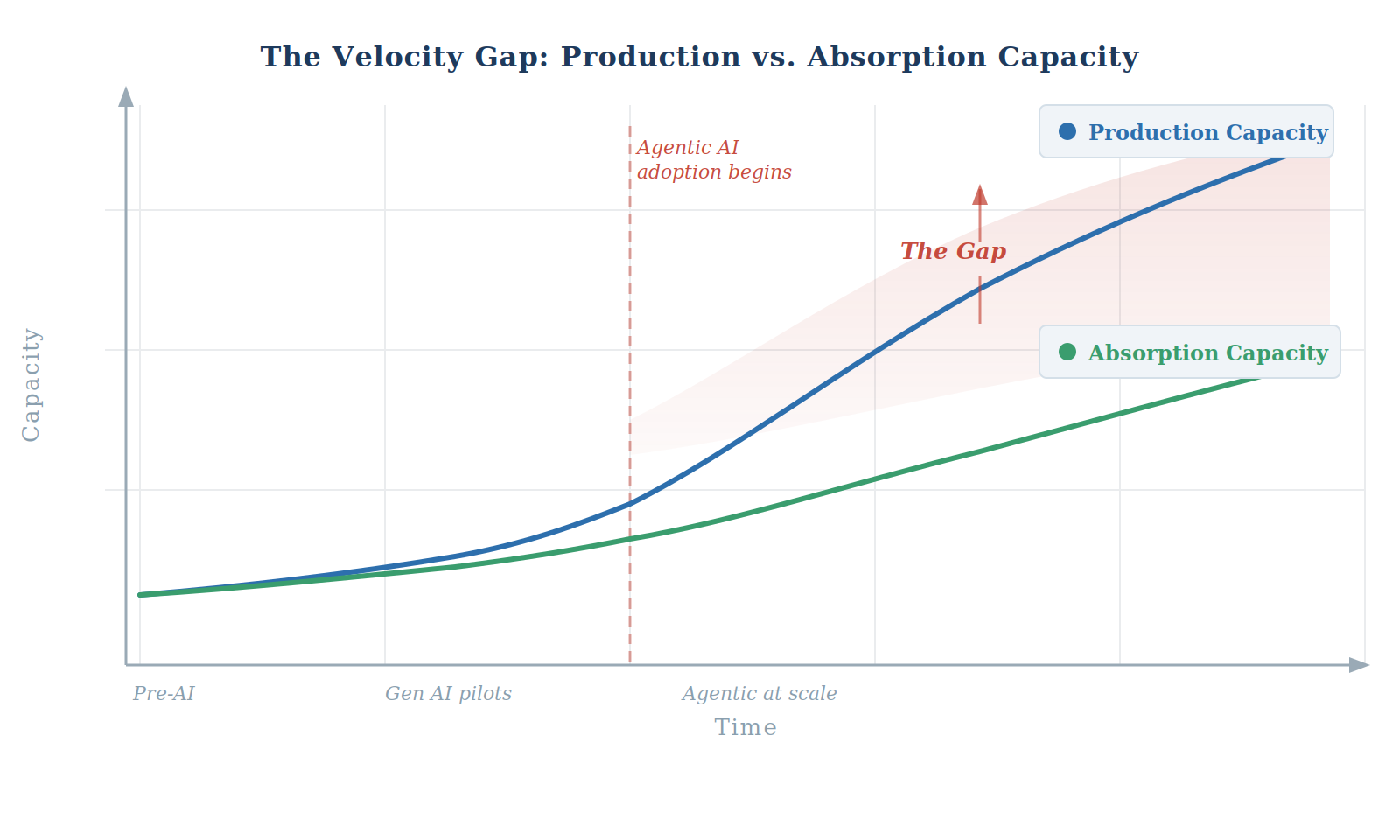
Production is climbing. Absorption is not keeping pace. That is the gap, and most organizations are not measuring it because they have never had to. The natural brakes of the previous era gave the system time to absorb what was being deployed. Those brakes are gone. What replaced them is a question most enterprises have not yet asked — until the returns fail to materialize.
A BCG study from 2025 found that only 5% of companies have achieved AI value at scale, while 60% report no material returns despite substantial investment.[2] That is not a technology problem. The tools are working. The gap is the organizational capability to land change well — to put it somewhere it actually takes hold, in the hands of people who are ready to use it, in systems stable enough to carry it.
Change Saturation
Market and customer saturation from change overload follows a recognizable pattern. You can feel when you’re overburdened with change, and you can see it in your customers. It looks like resistance and disengagement.
Most organizations misread those signals when they appear. They diagnose a communication problem, a training gap, a product issue. The response drives more activity, which compounds the original problem. By the time the real cause surfaces, the organization is already in stage three of a pattern that was entirely visible from stage one — to anyone who was looking at the right thing.
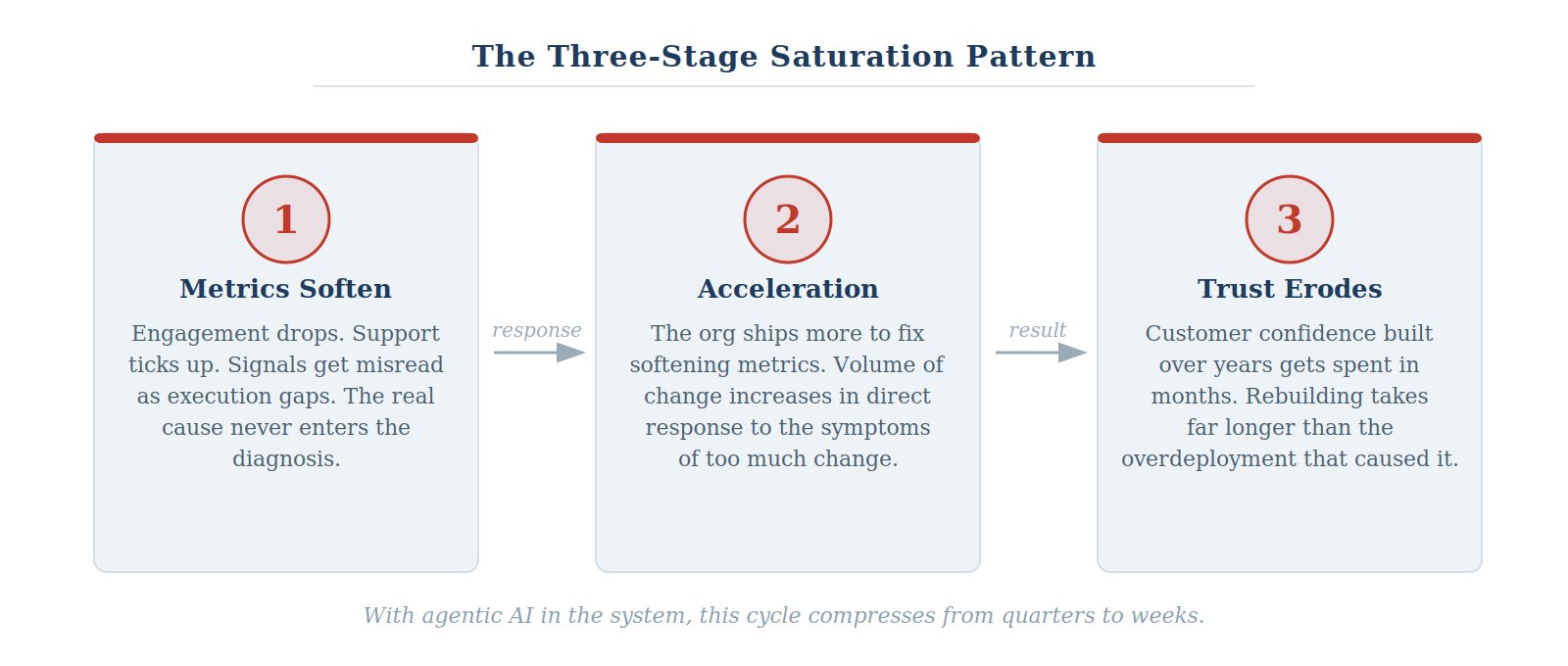
The Three-Stage Saturation Pattern
First, engagement metrics soften. Not collapse. Soften. Customers interact a little less. Support tickets start referencing confusion about recent changes. Employees ask a few more questions about why things work differently now, and long-tenured people quietly stop volunteering ideas. These signals get attributed to execution problems, communication gaps, or training deficits. The real cause, cumulative change burden exceeding absorption capacity, never makes it into the diagnosis.
Second, the organization accelerates in response. Because the metrics softened, there is pressure to ship the next thing. Surely the next feature, the next product, the next release will turn the curve. The volume of change goes up in direct response to the symptoms of too much change. This is the pattern that turns a manageable problem into a structural one.
Third, trust erodes in ways that take years to rebuild. The customer who once gave you benefit of the doubt stops extending it. The employee who once championed the new way of working starts keeping her head down. The institutional confidence built over a decade gets spent in eighteen months of overdeployment.
By the time the pattern is visible to leadership, the cost is already sunk. The organizations that hit this wall with AI velocity in the system will hit it faster and harder than anything the digital transformation era produced.
The organizations that will win this era are not the fastest deployers of agentic capability. They are the ones that build, alongside that capability, a rigorous and continuous answer to one question: what is landing on our customers and our people right now, and what is their remaining capacity to receive more?
Absorption Capacity
I have sat across the table from a lot of leaders who hear “absorption capacity” and think it is a case for slowing down. It is not. It is a case for knowing what you are doing to your customers before they tell you.
The organizations I have watched get this right share one thing: they know where their customers are. Not in a CRM sense. In a change sense. Which segments are still orienting to the last release. Which employees are running on fumes from the last reorganization. Which products have been touched so many times in twelve months that the people using them have stopped trusting them.
That knowledge shapes sequencing. What goes next. What waits. What needs a stabilization period before the next build lands on top of it.
MIT Sloan Management Review’s 2025 research on the agentic enterprise, conducted with BCG across 2,100 executives in 116 countries, underlines the point: the organizations that thrive focus less on the technology itself and more on the human systems that surround it.[3] Most enterprises have not operationalized that observation. They are still governing AI adoption the way they governed software releases, which was already not working before the velocity got 10x faster.
You cannot manage change absorption from a program dashboard. You need signals from the delivery layer, the product layer, the customer layer, and the organizational layer, running continuously, visible in relation to one another. You need a framework that surfaces the problem before it becomes a crisis, not after it shows up in quarterly metrics.
The Change Radar
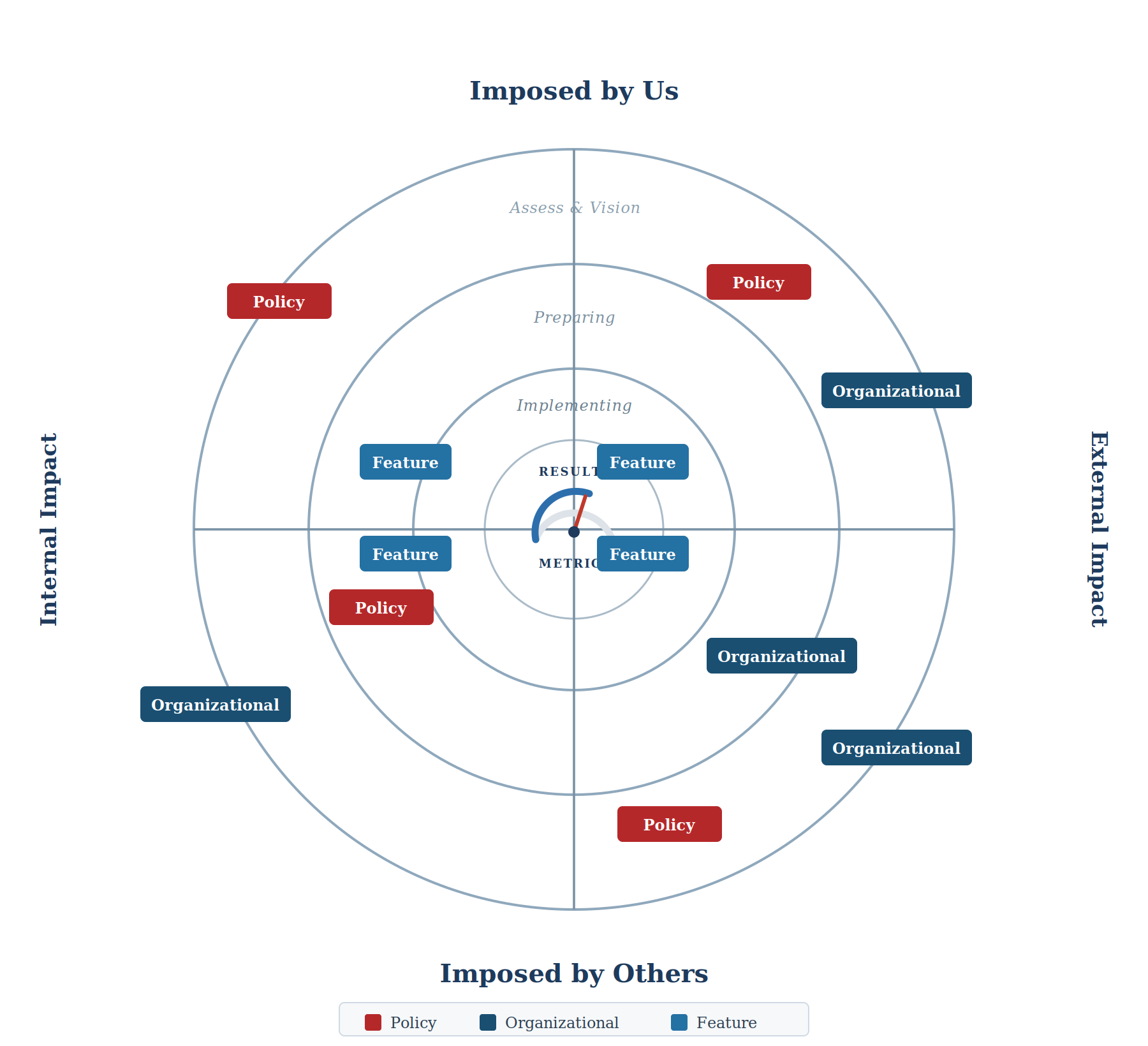
Years ago, working through one of the earlier transformation waves, I came across a concept called the change radar. It came from a persistent frustration: organizations were consistently surprised by change that had been visible for months to anyone with the right vantage point. Not unpredictability. The absence of any shared visualization of what was already in flight.
Hard to prepare for what you cannot see, and most change falls into that category. To stop inundating an organization and its customers with more than they can absorb, we need a mechanism to make the invisible visible.
The change radar organizes all change across two axes. The first is origin: who is driving the change? Some of it we are imposing — new products, new platforms, restructured experiences. Some is being imposed on us — regulatory shifts, competitive moves, market pressure. Both consume organizational and customer capacity, and most change management frameworks only account for the first. The second axis is impact: does this change land on our internal organization, our people and processes, or on our external customers and market?
Mapped across those axes, with a horizon model distinguishing between change that is assessing and visioning, change that is preparing, and change that is actively implementing, you get something most executive teams have never seen clearly: the full picture of cumulative change landing on any given audience at any given moment.
Think of it the way air traffic controllers manage a major hub. At any point, hundreds of aircraft are in motion simultaneously. The controller’s job is not to determine whether flying is a good idea. It is to manage sequencing, spacing, and load so everything can land safely. The radar does not slow the planes down. It makes the density visible so the right decisions can be made about what comes next.
That is what the change radar does for enterprise transformation.
Unlike a change advisory board or a program status dashboard, the radar is cumulative, cross-layer, and continuous. It does not ask whether one initiative is ready to launch. It asks what the entire change environment looks like for a given audience at a given moment — including what is being imposed on them from outside the organization.
The value compounds when layered against portfolio and program prioritization. Most portfolio decisions are made against one question: can we build it? The change radar adds the prior question: can our customers and organization receive it right now? If the answer is no, the sequencing decision is not to delay the work. It is to identify what must land first to create the capacity for what comes next.
As is often said: timing is everything. If we land the right change at the wrong time, we risk losing the strategic opportunity it was designed to create.
In the agentic AI era, this is not a governance artifact for large change programs. It is the fundamental discipline for responsible velocity. The agents will produce, continuously, across every surface. The question is whether leadership has the instrumentation to sequence what gets deployed, when, against a real model of customer and organizational readiness.
What Sustains the Advantage
I wrote recently about why the transformation program model keeps failing. The argument was structural: programs are designed to end, and the capability they build dissipates when the program closes. The organizations that break the cycle are the ones that build continuous modernization into their operating model permanently. Not as an initiative. As how they operate.[4]
The change radar is part of that. Not a one-time assessment. A continuous instrumentation layer that sits alongside your portfolio, your delivery system, and your customer feedback loops. It makes the question of change capacity a standing discipline rather than something that surfaces in a crisis.
The organizations I have watched absorb agentic AI capability well share a common characteristic: someone is tracking the cumulative weight of what is landing on customers and people, in real time, with enough visibility to make sequencing decisions before the damage is done. The ones that struggle are not less ambitious. They are less instrumented.
Most organizations are not stuck because they lack the ambition to change. They are stuck because they have never built the muscle that makes change visible before it becomes damage.
The goal is an organization that does not need to be rescued from its own velocity. One that can see its system clearly enough to deploy at the pace that compounds its advantage rather than erodes its foundation.
A Risk of the Agentic Era
The enterprise technology conversation right now is dominated by one concern: falling behind. The risk of being outpaced by competitors who move faster on AI adoption. That risk is real.
The one I am watching is the other side of it. Organizations spending their most valuable asset — customer trust and employee confidence — faster than any productivity gain can replace it. Moving so fast, with so little visibility into the cumulative change burden they are creating, that the damage is already done before anyone sees it coming.
The financial services company I described earlier recovered. Slowly, carefully, by getting serious about what their customers actually needed and rebuilding the clarity they had traded for ambition. It cost them years. They did it in a relatively slow-moving deployment environment, where the damage accumulated over quarters.
With agentic AI in the system, that same pattern plays out over weeks.
The leaders who navigate this era well are the ones who can hold two things simultaneously: speed is a genuine competitive advantage, and the pace of change must be calibrated against the real capacity of the humans on the receiving end.
That calibration requires visibility. Visibility requires instrumentation. And instrumentation requires the kind of deliberate, continuous operating discipline that transformation programs were never designed to build.
The constraint is not what you can produce.
It is what the world can receive.
The organizations that build the discipline to see that clearly, and continuously, are the ones that will still be compounding their advantage when everyone else is in recovery.
References
[1] Gartner, Predicts 2025: Agentic AI — 33% of enterprise software to embed agentic AI by 2028; 15% of daily work decisions made autonomously by 2028. Reported via RCR Wireless, June 2025.
[2] BCG, The Widening AI Value Gap, 2025. Only 5% of companies have achieved AI value at scale; 60% report no material returns despite substantial investment.
[3] MIT Sloan Management Review and BCG, The Emerging Agentic Enterprise: How Leaders Must Navigate a New Age of AI, November 2025. Global survey of 2,102 senior executives across 21 industries and 116 countries.
[4] BCG, Flipping the Odds of Digital Transformation Success, 2020/updated 2024. Roughly 70% of digital transformation initiatives fail to achieve stated objectives.