
Before You Cut a Tube, Prove the Geometry
How digital twins, set-based design, and additive manufacturing collapsed years of development into weeks at Valor Cycles

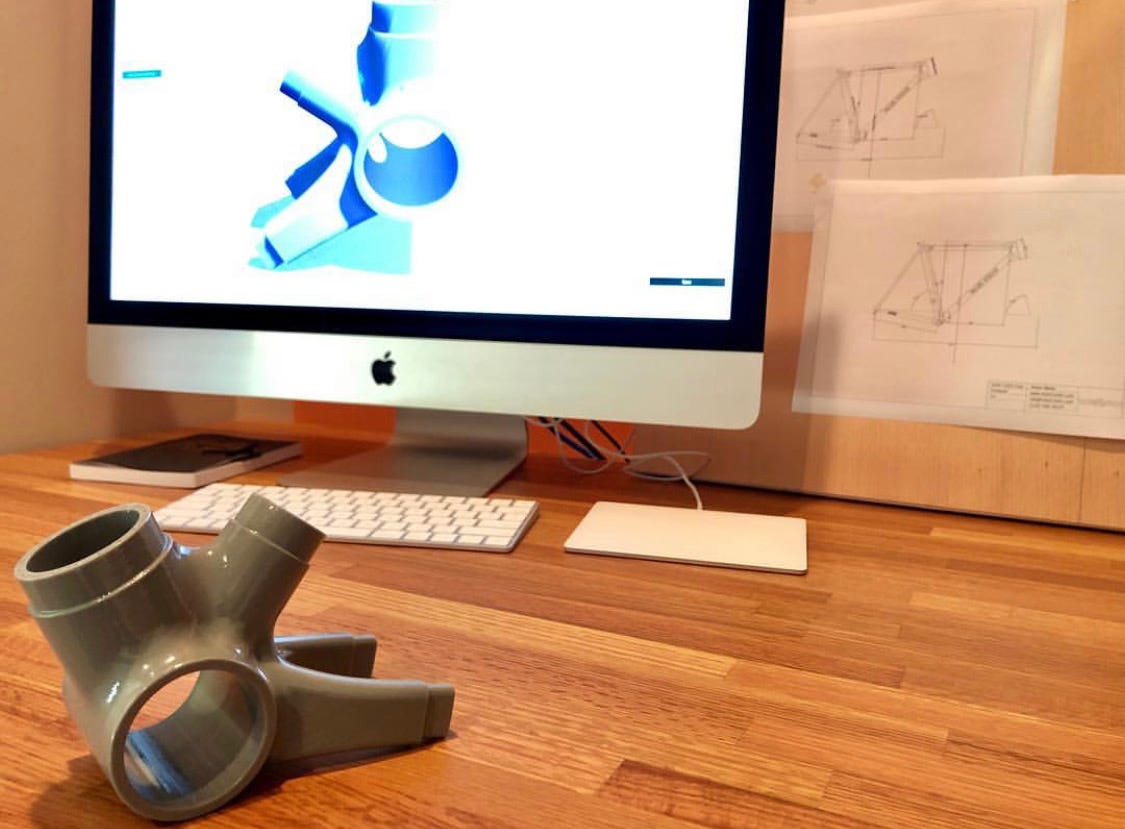
In 2018 I started Valor Cycles with one goal: win a stage of the Tour de France riding a 3D-printed carbon fiber road bike built in Texas. I wanted to manufacture the first frame serious enough to compete at that level. No European supply chain or Asian frames. A completely bespoke bike with production capacity at scale. Just great engineering, great people, and a process that could outlearn the incumbents.
What I had going for me was method (it certainly was not money).
The incumbents had decades of experience hand-laying carbon, testing across countless seasons, accumulating institutional knowledge in every gram of their geometry. I had a Mac Pro, a Markforged printer, and a conviction that rapid learning cycles could compress what normally took years into something that fit inside a tight budget and timeline.
I was not wrong about the method, but I was wrong about the timeline for what it would take to execute at scale. That is a separate story. The method itself holds, and it holds for a lot more than bicycle frames.
Traditional manufacturing is slow learning.
Hardware development has a dirty secret: you do not find out whether your design was right until you have already spent the money to make it physical. Hardware is expensive. Tooling, production lines, machining time — every iteration has a real price tag. That is the sequence that governs most product development: draw it, model it, manufacture it, test it, discover what you got wrong, start over. Each iteration costs months and tens to hundreds of thousands of dollars in tooling, materials, and machining time. For something as performance-sensitive as a competitive race frame, where the difference between a winning geometry and a mediocre one is a few millimeters of bottom bracket drop or a degree of head tube angle, that sequence is punishing.
The traditional response to that problem is experience. You hire people who have built enough frames that their intuition is already calibrated. You let them make the calls. You move forward on one design, you commit, and you live with what you get.
That is point-based design, and it is exactly the wrong model when you are trying to go fast and you are not carrying twenty years of institutional knowledge in your back pocket.
Set-based design.
Toyota did not build the Prius by picking one powertrain architecture and betting everything on it. Their engineers held multiple viable concepts in parallel, ran them against each other with simulated and physical data, and progressively eliminated options as evidence accumulated. They committed late, to the design that had earned commitment. That discipline has a name: set-based concurrent engineering.
The principle is simple. Instead of asking “which design should we build?” at the beginning of a program, you ask “which designs can we eliminate?” You keep the set wide while the cost of being wrong is low (simulation), and you narrow it as the cost of being wrong rises (physical prototype, tooling, production).
Most organizations do the opposite. They pick early because picking feels like progress. It is not. It is just spending your optionality before you have the data to spend it well.
For Valor Cycles, set-based design meant I could simultaneously test multiple tube diameters, multiple lug profiles, multiple lug geometries, and multiple layup orientations in simulation before a single gram of carbon touched a print bed. Every option that failed in the digital environment cost me nothing but computation time. Only the survivors earned the right to become physical.
The digital twin.
There is a version of “digital twin” that is basically a 3D model with good lighting. That is not what I am talking about.
A genuine digital twin is a physics-faithful simulation of your design under real operating conditions. For a road racing bicycle, that means finite element analysis of the frame under sprint loads, climbing loads, and sprinting-out-of-the-saddle loads. It means computational fluid dynamics to understand how tube shapes interact with airflow at race speeds. It means modeling how a carbon layup behaves under fatigue, not just under static peak load.
When you have that, you can test a geometry hypothesis in hours. You can ask what happens to the bottom bracket stiffness if you increase the chainstay diameter by two millimeters. You can ask whether a tapered seat tube adds measurable compliance without losing power transfer. You can run those questions against ten different tube configurations simultaneously, overnight, and wake up with actual data.
That data then drives the set-based elimination process. You are not guessing. You are converging on evidence.
The research supports this pattern at scale. Studies on concurrent engineering in aerospace and automotive programs consistently find that organizations using simulation-led, set-based approaches reach validated designs faster and at lower total development cost than those relying on sequential physical prototyping.[1] The upfront investment in simulation fidelity pays out quickly once the first iteration of physical prototyping begins with a geometry that has already survived a battery of virtual tests.
3D printing.
Once the digital twin had done its work and the set had converged on a winning geometry, I still needed to make it physical. That is where the Markforged came in.
The specific process I used was chopped carbon fiber printing to produce bespoke lugs that could interface with the frame’s main tubes. In traditional frame building, lugs are the junction components that connect tubes at the head tube, bottom bracket, and seat cluster. They are the most structurally demanding parts of the frame, and in carbon construction, they are also the most expensive to tool. A custom lug geometry in traditional manufacturing means a mold, and a mold means months and significant capital before you have tested a single hypothesis.
With the Markforged, I could print a lug geometry that was exactly calibrated to what the simulation said it needed to be. Not a standard profile from a catalog. Not a compromise because the tooling was cost-prohibitive. The exact profile the physics demanded.
That is the bridge that additive manufacturing builds between the digital twin and the validated prototype. You are not waiting for a supplier to make tooling. You are not ordering components that are close but not quite right. You are printing the geometry the simulation selected, testing it physically, confirming the model’s predictions, and iterating from there.
The time to a validated physical component in that workflow is not months. It is days to weeks. The cost reduction relative to traditional tooling-dependent prototyping is not marginal. For bespoke lugs, it can be an order of magnitude or more.
GE Aviation has published extensively on additive-enabled design iteration for turbine components, documenting cycle time reductions of 70 percent or greater when simulation-led design is combined with additive prototyping versus traditional machined and cast alternatives.[2] The mechanism is the same regardless of the material or the application: you are eliminating the tooling dependency that previously made each physical iteration expensive and slow.
Dirty dirty MVPs.
The prototypes I built at Valor Cycles were not pretty. They were not Instagram content. Some of them were printed lugs connected to PVC pipe sections, because all I needed to validate at that stage was geometry and load path, not finish quality. They looked like something you would find in an engineering lab, which is exactly what they were.
That is what a real MVP looks like. Not a polished proof of concept designed to impress investors. A minimum credible test of a specific hypothesis, executed as cheaply and as quickly as possible, designed to tell you whether you are right or wrong before you spend the real money.
The discipline required is not technical. It is psychological. Most people have a hard time showing an ugly prototype because it feels like an admission of incompleteness. It is not. It is an acknowledgment that the physics does not care about the surface finish, and that the goal at this stage is not beauty. It is data.
The digital twin and the additive printer together enforce that discipline, because they make it structurally easy to be disciplined. When testing a geometry in simulation costs you nothing and printing a test component costs you a day and some material, you stop having arguments about whether to commit to a design before you know if it works. The answer is always the same: test it first.
The conclusion.
Valor Cycles did not make it to the Tour de France. I reached a point where I had enough data from the digital twin and the physical prototypes to know what the path forward would require, and I made an honest assessment: I did not have the time or the capital to execute it at the level the goal demanded. I called it.
That was the right call. It was also only possible because the method I had used gave me real information instead of sunk-cost momentum. If I had been twelve months and two million dollars into a traditional tooling-dependent development process, the psychology of walking away would have been completely different. The process would have been generating pressure to continue, not information to evaluate.
That is the underappreciated value of digital twins and additive prototyping for hardware development. They do not just speed things up. They keep your options open longer. They let you learn cheaply enough that when the data says stop, you can stop.
Not every hypothesis is worth executing. The ones worth executing deserve the most rigorous, most efficient validation process you can build. That is what this combination of tools makes possible.
Three questions to ask.
Before the next hardware development cycle begins, these are worth working through explicitly.
How many design concepts are you eliminating in simulation versus in physical prototypes? If the answer is most of them in physical prototypes, the process is backwards. Simulation should do the heavy elimination work. Physical testing should confirm what simulation already predicted.
Where in your geometry space are you making early commitments that are hard to reverse? Set-based design is not about avoiding commitment. It is about making commitments when the data supports them, not before. Identify the decisions where early commitment is costing you the most, and ask whether simulation could push that commitment point later.
What is the actual cost of your first physical prototype, including tooling and lead time? For many organizations, that number is large enough that the investment in simulation fidelity pays for itself on the first cycle. Run the math explicitly before the next program starts.
The tools are accessible. The method is proven. The barrier is almost always the willingness to invest in the front end of the process rather than the familiar rush to make something physical.
Build it right in simulation first. Then print what survives.
[1] Ward, Allen C., and Durward Sobek. Lean Product and Process Development. Lean Enterprise Institute, 2014.
[2] GE Reports. “The FAA Approved GE’s First 3D Printed Part for a Commercial Jet Engine.” GE Aerospace, 2015.