

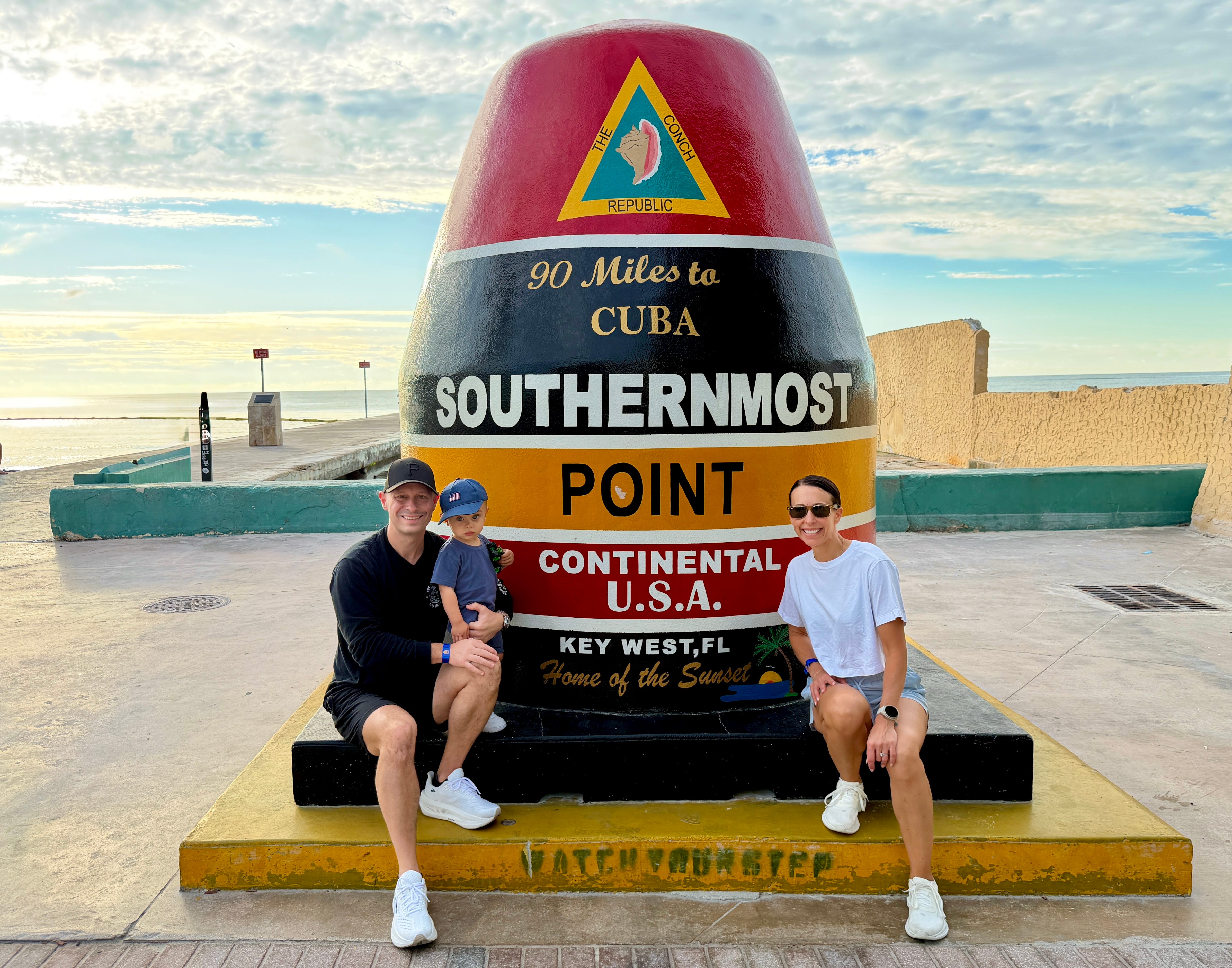
Last week I traveled to Key West for my brother-in-law’s wedding. He got married on Thursday, and we had an amazing few days with family.
Friday at dinner, the conversation took an unexpected turn. The FAA had issued a nationwide ground stop and my family’s flight back to Raleigh was canceled.
Everyone in our group needed to get home over the weekend: I had a client meeting. Nearly twenty others needed to get back to Johnstown, Pennsylvania, to staff an emergency room (yes, my family is nearly the entire ER staff). I briefly considered buying a car and driving home, which gives you some idea of where my head was.
The ground stop lifted Friday night, and everyone eventually made it home. But, what if the outage had lasted several days?
My client meeting could not be moved, and getting nearly twenty people home to staff an ER would have been a different problem. An aviation disruption could become a hospital staffing problem hundreds of miles away, without anything failing inside the hospital.
That dependency is easy to overlook until you’re sitting at dinner trying to work out how everyone gets home.
A difficult week for infrastructure
The FAA’s account describes network instability associated with a routine router replacement. Departures resumed that evening, though the disruption took longer to unwind.
Over the following days, Chase experienced transaction delays that it attributed to a software bug, and an NSA network used for classified communications went offline after what the agency described as routine maintenance.
Then came a different kind of report: a ransomware group claimed it had breached NVIDIA. As of this writing, the group had provided no proof. NVIDIA said it was investigating a possible incident involving a third-party partner and had found no indication that its own systems or networks were affected.
These events have different explanations and different levels of certainty. Treating them as one coordinated attack would get ahead of the evidence.
What concerns me is the operational dependence they expose, alongside a threat environment in which attackers can do more work, faster. The UK’s National Cyber Security Centre assesses that AI is increasing the speed, scale, and efficiency of cyber operations. Human operators still matter. AI gives them more capacity for reconnaissance, vulnerability research, and exploit development.
A disruption caused by ordinary maintenance is already difficult enough. We also have to understand what someone deliberately looking for a way through could reach.
That concern is why I built TSG/ControlBurn, which we launched with Frenos in October. Last week made it considerably more personal.
The partnership started in a Vegas suite
I met Brian Proctor, Frenos’s founder, in Las Vegas after TSG’s founder sent me a message asking me to meet him at the Aria Sky Suites. He had someone he wanted me to meet.
There was a group of us, an elevator ride, and an initially awkward meeting in a suite. I told Brian afterward that the setup felt a little like a mafia movie.
The conversation was much less mysterious: a group of nerds getting into technology and what we could do with it.
Brian had worked in OT cybersecurity at energy companies before moving into startups. He described Frenos as the platform he and his colleagues wished they’d had as practitioners. That background mattered. Operational technology controls physical processes, and the people responsible for those processes have good reasons to be cautious about security testing.
A test that interrupts a production line or interferes with a control system has created an operational problem of its own.
Frenos offered a way to investigate attack paths through a model of the network, using configuration, inventory, and vulnerability data. The simulated attacks run against the copy. According to Frenos, the platform requires no agents, scanning, or production access.
I’d first used digital twins for something very different. When I started Valor Cycles in 2018, I used Fusion 360 to simulate bike-frame geometries before cutting carbon tubes or printing the lugs that joined them. I wanted to learn what I could before committing material to a design.
The application here is different, but the appeal was familiar: investigate the consequences of a decision while changing it is still relatively cheap.
The model needs an operating process around it
The offering was originally called RedZone. Brian liked the football reference. I made some marketing for it that I described to him as a solid four out of ten.
The name became TSG/ControlBurn. The reason for wrapping TSG’s services around Frenos stayed the same.
A simulation can identify a modeled route to a critical asset. Someone still has to establish whether the underlying data is current, understand what the asset does, and decide which mitigation the operation can tolerate.
For example, restricting a vendor’s remote access might close a path in the model. Before implementing it, the team needs to understand whether that access supports equipment they depend on, what alternative is available, and how to reverse the change if necessary. Operations has to be able to approve the work with that information in front of it.
That is where TSG takes responsibility: preparing the data, working through the findings with the client’s engineers, and helping get approved remediation done.
We’ve structured the offering around how much help the client needs. Foundation establishes the findings and roadmap. Implementation adds help making approved changes. Managed Service provides recurring simulation, validation, and remediation as the environment and threats change.
The client retains authority over operational changes.
Yesterday’s answer needs checking
In the white paper I wrote for the launch, The Assessment Half-Life, I describe how ordinary change erodes the usefulness of an assessment. A new vendor connection, a firewall rule, or a newly disclosed vulnerability can change the answer without waiting for the next annual test.
The model has the same problem if nobody refreshes it. Old configuration exports give you answers about an old environment. Missing connections and unsupported assumptions need to be visible to the people using the results.
We also need to be precise about what validation establishes. A path disappearing from a refreshed model is useful evidence about that path under the model’s assumptions. Engineers still have to judge what the evidence supports and where further investigation is needed.
For a proposed change, we can examine the modeled paths before approval. After implementation, we can refresh the inputs and check the result. That makes validation part of the work of changing the environment.
ControlBurn addresses a specific part of resilience: understanding how an adversary could reach critical operational systems and helping close those routes. Organizations still need reliable maintenance, recovery plans, and people who know how to operate through a failure.
Last Friday, everyone in our group got home. I’m grateful for that, especially for the people who had patients waiting on the other end of the trip.
The question I want leaders to ask is practical: if a system you depend on stays unavailable for several days, what else becomes difficult—and how much of that dependency have you actually tested?
You can read The Assessment Half-Life and learn about TSG/ControlBurn here, or send me a note.
Enjoyed how you connect digital twins with daily life, physical products and agents.